Introduction: The Decision Every Pakistani Homeowner Faces
You have just completed the grey structure of your house. The first floor slab is cast, the parapet wall is up, and now comes one of the most debated finishing decisions in residential construction – do you paint the terrace wall or clad it with stone?
Terrace wall paint vs stone cladding is not merely an aesthetic question. It directly affects your home’s weather resistance, long-term maintenance cost, resale value, and how the exterior elevation reads from the street. In premium housing societies like DHA Lahore, DHA Islamabad, and Bahria Town, this single decision can visually separate a house that looks finished from one that looks incomplete — even if both are structurally sound.
As a civil engineer with over a decade of residential project experience across DHA phases, I have seen both choices made well and made poorly. This guide gives you the full, honest picture – costs, performance, climate suitability, stone types including travertine and Chakwal stone, and a clear verdict on which option fits which budget and goal
What Is a Terrace Wall (Parapet Wall) and Why Does Its Finish Matter?
The terrace wall – technically called a parapet wall – is the low boundary wall constructed at the edge of your first floor roof slab. In standard Pakistani residential construction, it rises 3 to 4 feet above the slab level. Its primary function is safety: preventing falls from the terrace. Its secondary and increasingly important function is architectural: it defines the upper shape of your home’s exterior.
What makes the parapet and terrace wall finishing decision uniquely challenging is its exposure profile towards the road. Unlike a ground-floor wall that is partially shielded, the terrace parapet is exposed to weather from multiple sides simultaneously:
- Direct sunlight UV degradation, heat expansion
- Rain from all directions in monsoon top surface, front face, and back face
- Monsoon moisture seeping into the wall-slab junction
- Dust and pollution accumulation on the face
- Temperature cycling — expansion and contraction between day and night
A finish that performs adequately on a ground-floor wall may fail within two years on a terrace parapet. This is why the choice between paint and stone cladding carries more weight here than almost anywhere else on the building envelope.
Option 1: Weather Resistant Paint for Terrace Walls
Paint remains the most common finish for terrace parapet walls in Pakistan primarily because it is fast, affordable, and familiar. However, not all exterior paint performs equally in the harsh conditions a terrace wall faces.
Types of Exterior Paint Suitable for Terrace Walls
For a terrace parapet wall in Pakistan’s climate, standard emulsion paint is not adequate. The right product category is weather resistant or elastomeric exterior paint, formulated to bridge hairline cracks and resist UV degradation.
- Dulux Weather shield – the most widely specified brand in DHA Lahore projects; good crack-bridging ability and color retention
- Berger Weather Coat – competitive alternative with strong alkali resistance, important for fresh cement surfaces
- Jotun Jota shield Extreme – premium tier, excellent for Karachi’s coastal humidity and Lahore’s extreme summer heat
- Nippon Weather bond – newer entrant, good UV resistance, mid-price range
Important: Rates above are for material only and assume proper surface preparation — cement plaster, alkali primer, and two finish coats. Labour adds PKR 8–15 per sq ft. Skipping primer on a fresh cement wall causes paint failure within 12 months regardless of brand.
Option 2: Stone Cladding for Terrace Walls
Stone cladding means fixing thin panels or tiles of natural or engineered stone onto the face of your terrace parapet wall using cement-based adhesive mortar. It is both a finish and a protective skin adding texture beauty and a layer of weather resistance simultaneously.
In the Pakistani market, two stone types dominate terrace wall cladding at different price points: Chakwal stone (local, budget-to-mid) and travertine (imported or locally available, mid-to-premium).
Chakwal Stone Cladding
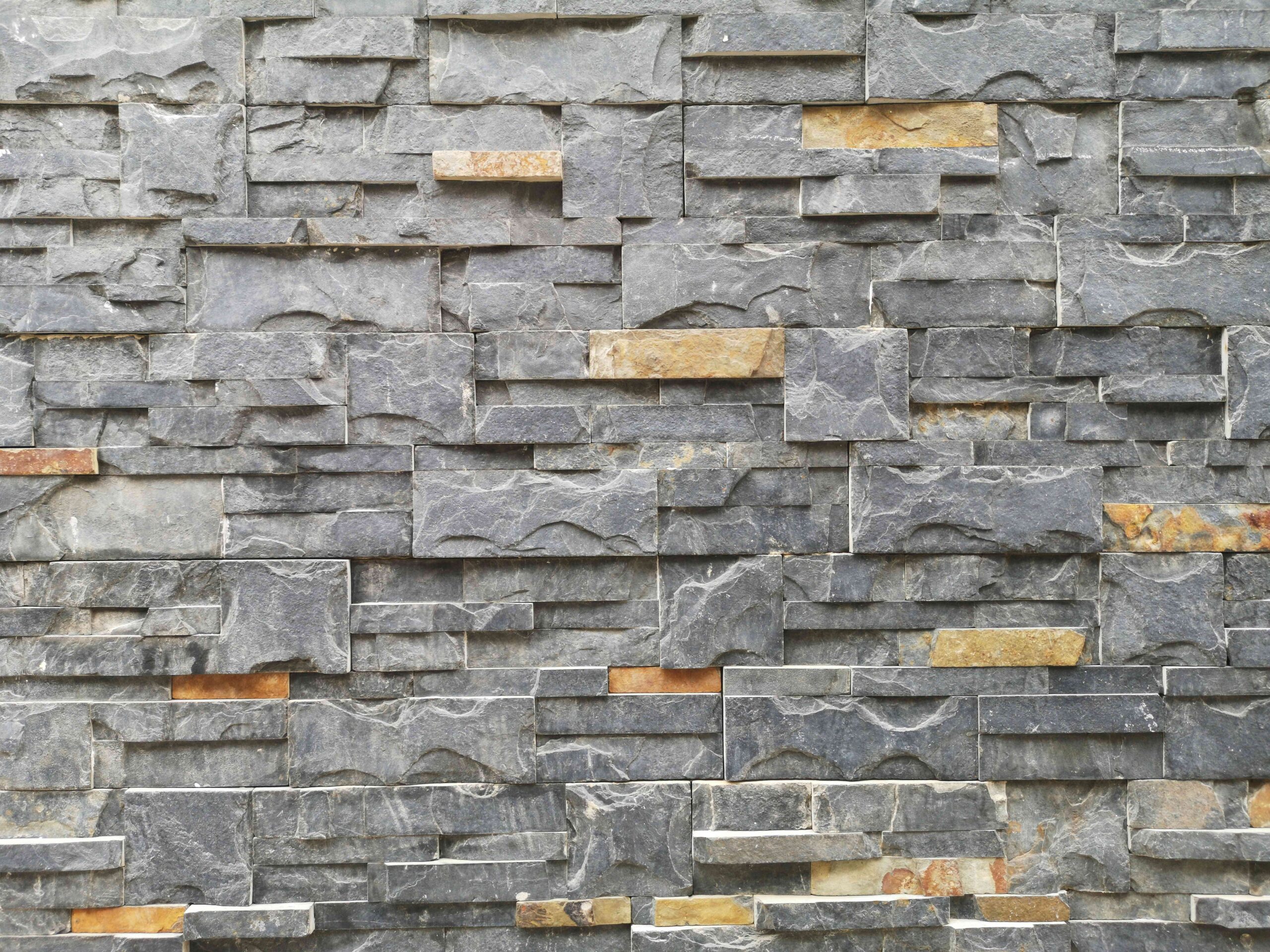
Chakwal stone is quarried from the Chakwal district of Punjab and is one of the most widely used natural stones in Pakistani residential construction. It is a sedimentary limestone with a rustic, layered texture that works beautifully on parapet walls, boundary walls, and front elevations.
- Natural earth tones – beige, brown, grey, and charcoal varieties available
- Rough split face or smooth cut finish options
- Cost: PKR 80–160 per sq ft (material only); installation adds PKR 40–70 per sq ft
- Durability: 20–40 years with minimal maintenance when properly pointed
- Widely available in Lahore, Islamabad, and Rawalpindi markets
Travertine Stone Cladding
Travertine is a natural limestone formed near geothermal springs, characterised by its distinctive porous surface, warm ivory-to-walnut colour palette, and refined aesthetic. When fixed on a terrace parapet wall, travertine elevates the entire exterior elevation to a premium level instantly recognisable in DHA Phase 6, 8, and Gulberg Greens projects.
- Colour range: ivory, walnut, silver, gold, and noce (dark walnut) varieties
- Available in honed, tumbled, or brushed finishes — each giving a different look
- Cost: PKR 180–380 per sq ft (material); installation PKR 60–90 per sq ft
- Requires sealing every 3–5 years — travertine is porous and absorbs water if left unsealed
- Adds significant resale premium, particularly in DHA and Bahria Town premium phases
Note: Costs above assume standard parapet wall surface. Prices vary by city – Lahore and Islamabad markets are typically 10–15% higher than Multan or Faisalabad for natural stone. Always obtain a site-specific quotation.
Which Option Is Right for You? A Practical Decision Framework
Frequently Asked Questions
Q: Is fixing travertine on a terrace wall considered stone cladding?
A: Yes, absolutely. Stone cladding is the broad term for fixing any natural or engineered stone onto a wall surface. Travertine is simply a specific type of natural limestone used as the cladding material. Whether you fix Chakwal stone, travertine, sandstone, or slate on your terrace parapet wall, all of these processes are correctly referred to as stone cladding.
Q: How much does it cost to clad a 5-marla terrace parapet wall with Chakwal stone in DHA Lahore?
A: A standard 5-marla house has approximately 120–160 sq ft of parapet wall face area (all four sides combined at 3–4 ft height). At installed Chakwal stone rates of PKR 120–230 per sq ft, the total cost ranges from PKR 14,000 to PKR 37,000. This is a one-time investment compared to repainting the same area every 4–5 years at PKR 5,000–10,000 per cycle.
Q: Does travertine hold up in Pakistan’s monsoon season?
A: Yes, but only if properly sealed. Travertine is a porous stone that will absorb water and stain if left unsealed. Apply a penetrating impregnating sealer before installation and re-seal every 3 to 5 years. With this maintenance, travertine performs excellently even in heavy monsoon conditions.
Q: Can I apply stone cladding over an already-painted terrace wall?
A: In most cases, no. Stone cladding adhesive requires a clean, unpainted masonry or plaster substrate for proper mechanical bond. Applying stone over paint risks delamination within a few years. The paint layer must be completely removed by mechanical means before stone fixing.
Q: Which looks better on a DHA house elevation — Chakwal stone or travertine on the parapet wall?
A: Both look significantly better than paint. Chakwal stone gives a warm, rustic character that suits traditional and transitional elevation styles. Travertine gives a refined, contemporary premium look more aligned with modern minimalist or Mediterranean-style elevations common in DHA Phase 6 and 8. Your elevation design should guide this choice consult your architect before ordering material.
Q: How long does exterior paint last on a terrace parapet wall in Lahore?
A: In Lahore’s climate — extreme summers, monsoon moisture, and winter condensation — even premium weather shield paint on a terrace parapet wall typically requires repainting every 4 to 6 years. Economy paints may need attention within 2 years. The parapet’s multi-directional exposure to sun and rain accelerates degradation compared to ground-floor walls
Conclusion: Paint vs Stone Cladding on Your Terrace Wall
Paint and stone cladding are not competing options for the same buyer — they serve different budgets, timelines, and ambitions. Paint is fast and affordable; stone cladding is a long-term investment in the quality and character of your home’s exterior.
Terrace wall paint vs stone cladding ultimately comes down to one question: are you finishing your house for living or investing in it for resale purpose? For DHA homeowners building to hold or sell in a market where visual quality drives price, stone cladding – whether Chakwal stone at the mid-range or travertine at the premium end – delivers a return that no amount of paint can match. For budget-constrained projects or interim finishes, a premium weather shield paint with proper waterproofing preparation is a sound and respectable choice.
Whichever route you choose, the single most important step is the one most often skipped: waterproofing the top surface of the parapet wall before applying any finish. That one detail, executed correctly, is what separates a terrace wall that looks great in year ten from one that’s cracking and staining by year three.